This blog covers the entire domain of sericulture. It is designed for providing a common platform for discussion between scientists, policy makers and students in the field. reproduction of content from this blog with due acknowledgement is encouraged.

Sunday, 12 January 2025

Impact of Social Networks on Farmers' Choice of Technology

Social Network Analysis (SNA) is a powerful tool for understanding the dynamics of social networks and their influence on the adoption of technology among farmers. By examining the interactions and relationships within a network, SNA can reveal how knowledge, information, and innovations are shared among its members. This article explores the impact of social networks on farmers' choice of technology, with a focus on the Sericulture Innovation System (SIS) in Karnataka, India.

Understanding Social Network Analysis

SNA is based on the premise that network ties play a crucial role in the dissemination of knowledge and innovations. The strength of these ties is determined by the number, frequency, and duration of interactions between actors, as well as the reciprocal services exchanged. In the context of farming communities, these ties can significantly influence the adoption of new technologies. The relationships between actors in a network are often represented by binary ties, which indicate the direction of information flow and can elicit an adoption response. The strength and direction of these ties are essential for understanding how innovations spread within a community.

The Sericulture Innovation System under investigation encompasses five villages in Sreerangapattana Taluk, Mandya District, Karnataka. This network includes 358 sericulture farmers, 30 Chawky Rearing Centres (CRC), five Chawky agents, 11 input suppliers, eight mulberry nurseries, eight mountage rental agencies, three cooperative societies, six markets, and eight government extension agencies. 


Measures of Network Cohesion

The network's cohesion, or interconnectedness, is a critical factor in its effectiveness. Cohesion is defined as the desire of individuals to maintain their connection with a particular group. It is important for achieving common tasks and is measured by various metrics, including average degree, network diameter, graph density, modularity, connected components, clustering coefficient, and path length.

The SIS network has an average of 9.7 links per node, a network diameter of 6, and an average path length of 2.6. However, only 5% of the potential links between farmers are present, indicating underutilization of the network's potential. This suggests that there is ample scope for promoting linkages between actors to enhance the network's effectiveness.

The network's cohesion can be further analyzed by examining the centrality measures of its actors. Centrality measures identify the most influential actors in a network and can provide insights into the flow of information and innovations.

Centrality Measures and Key Actors

Centrality measures include in-degree centrality, out-degree centrality, betweenness centrality, and eigenvector centrality. These measures help identify the most prominent actors, or "key players," in the network.

In-degree centrality measures the popularity of an actor, based on the number of times they are mentioned by others in the network. In the SIS, markets, mountage rental services, CRCs, Chawky agents, and extension agents exhibit high in-degree centrality, indicating their frequent approach by other actors. Among farmers, those who adopt new technologies (adopters) are more frequently approached for technical information.

Out-degree centrality measures the potential of actors to introduce innovations. Adopter-farmers are shown to be the best disseminators of innovations, aligning with previous research. This suggests that adopter-farmers play a crucial role in spreading new technologies within the network.

Betweenness centrality highlights the role of actors as intermediaries in information dissemination. Farmers who have adopted new technologies exhibit the highest betweenness centrality, accounting for 46.3% of all ties in the SIS. This implies that these farmers are key intermediaries in the network and play a significant role in the dissemination of innovations.

Eigenvector centrality considers the influence of an actor's connections. In the SIS, markets and rental services have high eigenvector centrality, indicating their importance in the network. However, caution is advised in interpreting these results, as high eigenvector values may arise from the inevitability of these organizations to farmers.

The Role of Farmers in Technology Adoption

Farmers, especially those who adopt new technologies, play a decisive role in the dissemination of knowledge within the SIS. The analysis reveals that opinion leaders in the network are predominantly non-adopters, suggesting that their influence may not encourage further adoption. This highlights the need for targeted extension interventions to convert these opinion leaders into adopters and advocates of new technologies.

The centrality measures of the top ten actors in the network indicate that farmers are the sole players in terms of closeness and betweenness centrality. This underscores the strong influence of farmers over other actors in the network as opinion makers. Among the most influential players are the farmer-cum-Chawky agent (F27), Market no.1 (M1), Extension agent no. 4 (E4), CRC no. 5 (C5), and Chawky agent no.1 (A1). 

Policy Implications

The SNA of the SIS reveals certain policy implications. First, there is a need to promote linkages between actors to fully exploit the network's potential. Second, extension policies should focus on creating favorable opinions among adopters and utilizing their influence to spread innovations. Third, targeted interventions are required to convert strong opinion leaders into adopters.

One particularly striking finding is the leadership roles played by the government extension officer (E4) and the farmer-cum-Chawky agent (F27). The SNA indicates that the village community has polarized into two groups under their respective influence. While these two leaders are personally well-connected, their personal relationship has not resulted in networking between the two groups they represent. 

Figure shows polarization of the village community into two separate networks around two different influencers. The green bubbles represent the members connected with extension officer E-4 as central node and the pink bubbles those, connected with farmer F-27 as central node (click to enlarge the picture)


This calls for policy intervention at two levels:

  1. Opening Channels of Communication: There is a need to create platforms for interaction between the two groups. This can be achieved through group discussions, focus group discussions, demonstration programs, and off-farm training programs. By facilitating communication between the groups, the favourable impact of new technologies can be shared more effectively.

  2. Targeted Extension Interventions: Given the strength of SNA in identifying key players, extension policies should focus on converting strong opinion leaders into adopters. Recognizing and educating these leaders can help them become strong advocates of new technologies, thereby enhancing the overall effectiveness of the network.

Conclusion

SNA provides valuable insights into the impact of social networks on farmers' choice of technology. In the SIS, farmers who adopt new technologies play a crucial role in disseminating knowledge and innovations. However, the network's potential is underutilized, and opinion leaders are predominantly non-adopters. By promoting linkages and targeting interventions, policymakers can enhance the adoption of new technologies and improve the overall effectiveness of the network.

The findings from the SNA of the SIS highlight the importance of social networks in the adoption of technology among farmers. By understanding the dynamics of these networks, policymakers can design more effective extension programs and interventions to promote the adoption of new technologies. This, in turn, can lead to increased productivity and sustainability in farming communities.

In summary, the impact of social networks on farmers' choice of technology is significant. The relationships and interactions within a network can greatly influence the dissemination of knowledge and innovations. By leveraging the insights gained from SNA, policymakers can create targeted interventions to enhance the adoption of new technologies and improve the overall effectiveness of agricultural innovation systems.


Monday, 11 May 2015

Facial mask and biomaterial applications of Nano silk sericin

R.K.Pandey, Regional Sericultural Research Station, Jammu 181101, pandeyjammu@gmail.com
What is Nanotechnology?
Nanotechnology, "the manufacturing technology of the 21st century," is defined as the understanding and control of matter at dimensions of roughly 1 to 100 nanometers (billionths of a meter, or 10 m.) A nanometer (nm) is one-billionth of a meter, or a millionth of a millimeter - smaller than the wavelength of visible light and a hundred-thousandth the width of a human hair. At this scale, unique properties of materials emerge which can be applied to produce technologies and products with entirely new abilities and applications. Nanotechnology (NT) involves imaging, measuring, modeling, and manipulating matter only a few nanometers in size. Nature already uses nanotechnology in the molecular machinery of every living thing. Nature's designs are working examples to us of what can be made. However, rather than using trial and error, we can apply intelligent design principles to our creations.
The Nano Age
According to futurist and inventor, Raymond Kurzweil, the Nanotech Age is expected to begin between 2025 and 2050, bringing an end to the current Information Age which began in 1990.  Coming is a Nano Revolution that will be at least as transformative as the Industrial Revolution (perhaps much more so), but packed into just a few years. Well beyond present-day nanotech applications, mature "molecular manufacturing" or "molecular nanotechnology" will enable us to manifest our dreams (or nightmares). We are nearing the ability to build molecules out of atoms mechanochemically, and to use these molecular building blocks to construct virtually any substance or device we can conceive of. This most powerful technology of all will radically transform and extend the capabilities of practically every area of human endeavor by exploring the ultimate limits of fabrication. Nanotechnology will become the most powerful tool the human species has ever used. With it, we will literally fashion the world of tomorrow into whatever we so desire.
 Nanomaterials
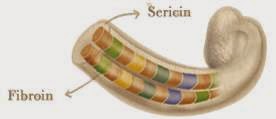
Materials having morphological features smaller than 100 nm in at least one dimension are Nan materials. This classification includes thin films, quantum dots, etc. When matter is reduced to the nanoscale (1 - 100 nm,) the effects of increased surface-area, in tandem with quantum effects, begin to dominate material properties. As a particle's size decreases, a greater proportion of its atoms are found at the surface compared with those inside. Larger surface area equals greater reactivity. Quantum confinement results in size-dependent property changes, meaning materials with nanoscale dimensions (Nano materials) can start to exhibit very different optical, electrical and magnetic properties, (especially as the structure or particle size approaches the smaller end of the nanoscale) compared to what they would on a macroscale. This effect has been likened to an expansion of the entire periodic table of the elements out into another dimension; as though we now have access to many new primary elements which did not exist before, enabling unique/novel applications. For instance, when made into nanoparticles, opaque substances may become transparent (copper); inert materials attain catalytic properties (platinum); stable materials turn combustible (aluminium); solids become liquids at room temperature (gold); insulators turn into conductors (silicon). Materials such as gold, which are chemically inert at normal scales, can serve as a potent chemical catalyst at the nanoscale. Much of the fascination and potential of nanotechnology stems from these unique surface area and quantum phenomena exhibited by matter at the nanoscale. Silk thread is a double strand of the fibroin held together by a substance which is gummy in nature; this gummy substance is the sericin protein. The chemical composition of silk filament is fibroin (70-80%), sericin (19-28%) and other matter plus ash contributes to (1.0-2.0%).

Nano silk sericin


Fig.1 Silk filament
  The waste water from silk industry largely contains the sericin group of proteins which are discarded unused and polluting the nearby area.  Sericin contains 18 amino acids including essential amino acids. The major amino acid compositions in sericin are 32% of serine, 18% aspartic acid and 16% glycine. The total amount of hydroxyl amino acids is 45.8%, polar amino acid 42.3% and nonpolar amino acid residues 12.2% in sericin.
 The waste water of degumming process of silk industry is utilized for the extraction of sericin group of proteins and its conversion to nano particles.
Extraction of sericin
 The 5 L waste water is centrifuged in a centrifuge at 4000 rpm for about 10 minutes to remove the suspended particles. The clear supernatant is concentrated in a rotary evaporator to about half of the original volume 2 L. The clear concentrated sericin solution is stored at 4oC for further use.
Preparation of nano sericin
The 48 g of urea is added to a 100 ml concentrated sericin solution to make the final concentration of urea to 8M. The solution is agitated continuously at 60oC for one hour. After cooling at room temperature, the solution is dialyzed using dialysis tubing against distilled water for 48 hrs. The distilled water is changed every 3 hrs, to remove urea completely. The solution is then subjected to lyophilization using Opera freeze dryer at
 -55 0C for 24hrs to get nano sericin in powder form. It contains 18 kinds of Amino Acids, including all 8 kinds of human needful ones.
APPLICATIONS    
 The sericin in nano form can be used in various applications. Recently, Silk sericin has been widely used in biomaterial applications due to its biocompatibility, biodegradability, and anti-oxidative and bioactive activities.
Cosmetics
Because the hydrophilic amino acids proportion reaches 80%, it has extraordinary excellent performance on humidity-control and skin protection as cosmetic materials. The colloid proteins protect and care one's skin and hair, forming the protective velum, keeping the skin moisture, preventing injury on skin stratum corneum and blocking off ultraviolet radiation. The sericin has good moisture absorbing characteristics so it can be used as a moisturizer in the cosmetics and it also gives glow to the skin.  The sericin shows gelling property at all conditions. This property can be used to replace the artificial binding agent used in perfume sticks. By making the sericin stable it is possible to increase the porosity in the perfume sticks which makes it easy for burning.
Wound healing
One of the major applications of tissue engineered skin substitutes for wound healing is to promote the healing of cutaneous wounds. As the sericin based hydrogel has the three dimensional cross linking property, it can be used as a scaffold in the tissue engineering effectively.
Anti microbial products
The sericin shows antibacterial properties. It can be widely used in the pharmaceutical products as an antibacterial agent. It is an excellent treatment for the cuts, wounds, burns, sores and skin infections. The sericin based hydrogel can be used in these applications as it can absorb moisture and has antimicrobial property. This property can be utilized to prevent the urinary tract infections. The anti-microbial activity of the Silk Sericin capped silver nitrate against gram-positive and gram-negative bacteria is confirmed.
Sericin is also reported to have diverse biological activities, such as anti-oxidation, anti-bacterium, anti-coagulation and promoting cell growth and differentiation. In the field of regenerative medicine, owing to its biodegradability, easy availability, and hydrophilicity with many polar side groups, sericin is mostly copolymerized, crosslinked, or blended with other polymers to form various scaffolds in order to help obtain improved properties for relevant biomedical applications, such as skin regeneration. Besides being jointly fabricated with other biomaterials, the possibility of using only pure sericin to generate scaffolds has just begun to be explored.
Facial mask paste from silk sericin
Acne, blackheads, white heads and blemishes are a problem that everyone at some point in their life has dealt with and not just in their youth. These issues affect people of all ages for various reasons. Hydrogel Mask provides superior quality over the conventional Serum-soaked cloth masks. Before the hydrogel masks appeared on the market, serum-soaked cloth masks were synonymous with the face masks, appealing to consumers with their ease of use and the great hydrating ability. Despite these merits, some users complain that they do not completely make contact with their skin or some essence ingredients run from the face.
Compared with the traditional standard essence masks, Hydrogel Mask provides extraordinary moisturizing quality that has been proven to be superior to the traditional essence masks by up to 18%.
What’s more, the new concept Thermo-Sensible Water-Soluble gel mask gradually melts its active ingredients into skin, reacting to the skin temperature. Genic has obtained patents regarding thermosensible quality and TCD (Transdermal Cosmetic Delivery System). It also utilizes the bio-matrix method, which is safe for the human body.
This gel mask has a great cooling effect and it keeps skin moisturized as well. The enhanced moistness and adhesive ability guarantees effective delivery of active ingredients into the deeper skin without damage, while resolving the problem of other sheet-type masks’ losing active ingredients.
Fig.2 Silk sericin facial mask
Even though nanotechnology is an emerging field of science greatly exploited in different sectors mainly electronics, energy, environment and health, its application in sericulture is rarely exploited in India and abroad. The research in this sector in India is still at a preliminary stage and also at a conceptual level to understand realistic assessments.

Reference
International Conference on Nano Science and Nanotechnology 2015
Int.J.ChemTech Res.7 (5), 2117-2124(2015)


Saturday, 15 November 2014

Occupational health problems in Silk production: A Review

Rakesh.K.Pandey
Regional Sericultural Research Station, Miransahib, Jammu, 181101, India
Abstract
 Even though, the Silkworm life cycle is eco friendly, silk industry involves certain health risks such as carbon monoxide poisoning in temperate area like Kashmir due to the use of burnt coal to raise room temperature, handling of diseased worms and excreta with bare hands, use of formaline and bleaching powder for disinfection, use of bed disinfectants made from paraformaldehyde, use of organophosphates pesticides to control mealy bug, leaf roller and white fly, use of chlorpyrifos to control termites. Beside, Grainage workers suffer from moth scales, which trigger asthma and conjunctivitis. While cocoons are put in hot water to loosen silk fibres for unwinding, the workers also put their bare hands in hot water, resulting in blisters in their hands leading to secondary infection, such as dermatitis. About 70 Benzidine based silk colorants such as azo dyes, release carcinogenic aromatic amines. Similarly, heavy metal complex dyes, are known to damage mental and central nervous function, lower energy levels and damage blood composition, lungs, kidneys and liver. Trivalent chromium used to fix silk dyes undergoes oxidation into hexavalent chromium, which leads to skin irritation, ulcers, sensitization and allergic contact dermatitis. Lead acetate used in dyeing silk cloth is a neurotoxin. It affects the human brain as well as reproductive system. Lead also affects reading and reasoning abilities in children. Dye factories across the world are dumping millions of tons of dye effluent into rivers without any effluent treatment. Pentachlorophenol, which is used in spray starch before ironing silk garment to protect from mould attack also, pose severe health problems. Formaldehyde resins routinely applied on silk to reduce shrinkage and wrinkling, cause eczematous rashes. Contact with silk cloth with a pH outside the accepted range (5.5), turns the skin flora out of balance and causes irritation. Dermatitis, narcosis, dizziness, fatigue, nausea, headache, eye irritation, adverse reproductive hazards including increased risk of miscarriage and serious neurological problems can all result from the processes of screen printing, where toluene, xylene and methyl ethyl ketone are used as solvents of the inks, thinners and clean up materials. Several health hazards are also associated with weaving and related activities, which cause stress and strain to weavers. Need of including eco parameters testing in issuing silk mark certificate is discussed
Sericulture industry is labour oriented agro industry employing 70 lakh people (5 lakh are sericulture farmers and the rest are stakeholders such as reelers, twisters, weavers, printers etc.) in India. About 23060 tonnes of silk is produced in India annually, which generates a turnover of Rs.25000 crore of which Rs.2500 crore is exported.
Silk production today is a blend of ancient techniques and modern innovations. The first stage of silk production is hatching the silkworm eggs, which have been previously examined and shown to be free from disease. Larvae are then fed cut-up mulberry leaves and after the fourth molt climb a twig placed near them and spin their silken cocoons. The silk is a continuous-filament fiber consisting of fibroin protein secreted from two salivary glands in the head of each larva, and a gum called sericin, which cements the two filaments together. Pupae within cocoons are killed by steam or fumigation to prevent adult emergence, which would cut and tangle the silk filaments. Cocoons are later softened in hot water to remove the sericin, thus freeing silk filaments for reeling. Single filaments are drawn from cocoons in water bowls and combined to form yarn. This yarn is drawn under tension through several guides and eventually wound onto reels. The yarn is dried, packed according to quality, and is now raw silk ready for marketing. Indian silk industry produces basically four types of silks namely Mulberry, Muga, Tasar, and Eri silk. Karnataka, Andhra Pradesh, Tamil Nadu, Jharkhand, Chhattisgarh, Orissa, Jammu & Kashmir and West Bengal are the major hubs of Indian silk industry. The traditional silk sarees like the Kanjeevaram sarees, Banarasi sarees, Konrad sarees, Mysore silk sarees, Pochampally Ikat sarees, Chanderi sarees, Paithani sarees, Patola sarees, Baluchari sarees, Bomkai sarees, Tasar sarees etc., are the exclusive creations of the artisans who use silk as the base material for these sarees. Among non-mulberry silks, Tasar is mostly produced by tribal people settled in different parts and regions of India.
Workers in sericulture industry are exposed to a number of health hazards. Various reproductive and menstrual risk factors for endometrial cancer have been identified, whereas few occupational or environmental risk factors have been explored. Several studies have investigated exposure to insecticides, specifically Organochlorine compounds, but no consistent associations have been reported. Although solvents are considered endocrine disruptors, the only study to date to specifically address solvent exposure and endometrial cancer detected no association (Wernli et al.2008). An association between occupational exposures and health nested within a large cohort of silk workers in India is reviewed here.
Health risk factors during silkworm rearing 
Wani and Jaiswal (2011) reported that majority of the rearers in Kashmir are suffering from health problems like, eye irritation, injuries, back pain, allergies, respiratory problems and headache.
Carbon monoxide
Coal Sigri used in silkworm rearing in temperate Kashmir
Carbon monoxide is known as a silent killer because it has no smell, colour or taste and can be produced by a faulty or poorly ventilated fuel-burning appliance such as partially burnt coal sigri used in Kashmir and other temperate areas to raise room temperature in cold condition. Symptoms of carbon monoxide toxicity consisting of headache, vertigo, nausea and vomiting. We lost a worker at Patnitop (J&K) in rearing room due to CO beyond tolerance level (100ppm). Cherry red lividity is seen in human body due to CO poisoning
Illness caused by unhygienic conditions of rearing
Unhygienic conditions due to accumulation of unutilized leaves and silkworm excreta pose health risk. Any negligence of hygiene leads to silkworm mortality due to two main diseases Grasserie & Flacherie. The dead silkworms, if not removed immediately, putrify and cause illness among rearers. 
Health Risk from Formalin used in the disinfection to maintain hygiene
Formaline spray with body mask
HCHO has strong irritant effect on the eyes and nasal mucous, when present in the air at levels exceeding 0.1ppm. HCHO is a   carcinogen. 2% solution of formaline is employed for spray in the rearing room and on rearing appliances such as trays in a closed room a day before the onset of rearing work.
Health Risk from Bleaching powder
Contact of bleaching powder with skin and eyes may cause severe injury, burns or death. Use of Only 2% solution is recommended for washing trays and rearing rooms
 Health Risk from Bed disinfectant (Paraformaldehyde
Bed disinfectants employed during silkworm rearing mainly consist of slaked lime and paraformaldehyde. Human Skin contact with bed disinfectants result in sensitization, inflammation of the eye (redness, watering and itching)
Health risk factors in mulberry plantation
Risk from 2,4-D Amine used for broad leaf Dicot weeds
Over the past 40 years, dozens of studies have shown the connection between 2,4-D and cancers of the blood
Parthenium: a problematic weed
 Health Risk from glyphosate for monocot weeds
Glyphosate is employed to control monocotyledon weeds such as Liver seed grass, Urochloa panicoides and Kyllinga brevifolia etc.Carcinogenic potential of Glyphosate , at extremely low concentration, is confirmed. 
Health Risk from chlorpyrifos for control of termites
Chlorpyrifos is used to control termites’ world over. Poisoning from chlorpyrifos affect the central nervous system, the cardio vascular, and the respiratory system in human being. It is also a skin and eye irritant
Health Risk from-hazardous organophosphate
Dichlorvos (DDVP) is employed to control pest attack on mulberry, such as tukra, leaf roller and white fly. Dichlorvos is known to induce neurophysiological and behavioural changes in human being
Tukra, Leaf roller, white fly in mulberry
 Health Risk from moth scales in eggs production (Grainage)
In the process of silkworm eggs production, male and female moths emerge from the cocoons, copulate and female moths lay eggs. The wings of moth are minutely scaled. The scale allergens trigger asthma, and Conjunctivitis. Around 9% grainage workers suffer from these problems.
Health Risk of Dermatitis in Reeling
While Cocoons are immersed in hot water to loosen fibres, workers tend to put their bare hands in hot water to see if the fibres are loosened to pick silk thread for unwinding. Hot water gives blisters in fingers leading to secondary infection like dermatitis
Dermatitis symptoms, reeling process
Health Risk from azo dyes
Government of India has notified Indian Eco Standards (Table-I) and prohibited manufacture and use of Benzidine based 70 dyes, which are known to break down into aryl amines.
The enzyme, azo-reductase, breaks down azo dye molecules into aromatic amines which are then absorbed in the intestine. These are especially hazardous to the workforce. The exporter of silk, have to make sure that their products do not carry any of the azo dyes that are prohibited in the western countries (EU).
Release of carcinogenic Benzidine from azo dyestuff


 Typical eco-parameters under the Eco-labels for finished textiles
 Health risk from Heavy metal complex dyes
Metal Complex Dyes are known for its fastness properties and hence find application in dyeing of silk.  Antimony, arsenic, bismuth, cadmium, cerium, chromium, cobalt, copper, gallium, gold, iron, lead, manganese, mercury, nickel, platinum, silver, tellurium,t hallium, tin, uranium,vanadium,and zinc comes under heavy metals category. Heavy metal toxicity can result in damaged or reduced mental and central nervous function, lower energy levels, and damage to blood composition, lungs, kidneys,and liver.
Health Risk from Chromium in metal complex dyes
Trivalent Chromium is used to fix silk dyes. It undergoes oxidation into Hexavalent Chromium. Exposure to Hexavalent chromium is hazardous to human health and increase the risk of developing lung cancer. Dermal exposure to Cr (VI) leads to skin irritation, ulcers, sensitization, and allergic contact dermatitis.
Effect of Hexavalent Chromium

Health risk from Lead absorption 
Lead is used in Lead acetate for dyeing of silk cloth, Lead molybdate in pigments used in dyestuffs and Lead nitrate in mordant in dyeing and oxidizer in dyeing .Lead is a neurotoxin – it affects the human brain and cognitive development, as well as the reproductive system. Some of the kinds of neurological damage caused by lead are not reversible. Specifically, it affects reading and reasoning abilities in children, and is also linked to hearing loss, speech delay, balance difficulties and violent tendencies.
Effect of different Lead levels (microgram/decilitre) in blood


 From Dyeing effluents
Dye factories across the world are dumping millions of tons of dye effluent into rivers. The dyeing effluents contain azo dyes, chromium, heavy metals etc.
In accordance with a Madras High court order, around 400 dyeing units were shut down by 2012 and their operating licences were cancelled and the power connections snapped. Only the factories that installed reverse osmosis equipment were allowed to operate.
Coloured Dye effluent into Ganga river at Varansi
 Health Risk from Pentachlorophenol (PCP) Organochlorine compound such as PCP are used in spray starch before ironing silk saree/garment to protect from mould attack. In humans, its bioaccumulation takes place and poses severe health hazard. Pentachlorophenol is a common ingredient in spray starch that often irritates the lungs. 
Mould attack on silk

Pentachlorophenol formula

 Health Risk from Formaldehyde resins
Use of formaldehyde in clothing is extremely widespread. There have even been lawsuits alleging high levels of it in Victoria's Secret bras. Formaldehyde is linked to a 30% increase in lung cancer, plus skin/lung irritation and contact dermatitis. It is found in fabrics claiming to be:
  1. Anti-cling, anti-static, anti-shrink
  2. Waterproof
  3. Perspiration-proof
  4. Moth-proof and mildew resistant
  5. Chorine resistant
It is also used in dyes and printing to fix the design and prevent "running". Eczematous scaly rash occurred after the patient wore a cap containing formaldehyde resins in the silk inner lining.
Eczematous rash on forehead due to cap

Health Risk from pH value
Human skin has a pH of about 5.5, acting as a barrier to bacteria, viruses and contaminations. Contact with materials with a pH outside the accepted range turns the skin flora out of balance and causes irritations. Eco mark (India) restricts pH of aqueous extract of the fibres between 4.0 and 7.5.
Health risk from screen printing solvents
The major hazard comes from exposure to the solvents, Toluene,Xylene,methyl ethyl ketone  in the inks, thinners, clean-up materials, (permitted<1 .0="" b="" ppm="">
Dermatitis, narcosis, dizziness, fatigue, nausea, headache, eye irritation, adverse reproductive hazards including increased  risk of miscarriage, and serious neurological problems can all result from the processes of screen printing
Health Risk of Handloom Silk weavers
Several health hazards are associated with weaving and related activities which may cause stress and strain to weavers and pose several health related risk factors to them
Ailments of silk weavers
Conclusion
Various types of occupational disorders are associated with silk industry such as, respiratory disorders, injuries, eyesight problems, nerve disorders, and carcinogenic skin problems. Most of these health risk factors can be avoided by proper precautions. Awareness programme and local group discussions are essential for improving the health status of these workers. There must be some provision of protecting equipments such as face masks, first aid facility, gloves and proper uniform. Silk mark protects the interests of consumers, who are being cheated by traders by selling spurious products in the name of silk. So far silk mark authorities test cocoons and raw silk only.  In order to safe guard health of the consumers, the silk mark should be clubbed with silk testing with reference to eco parameters of Textile testing laboratories as per the norms of Bureau of Indian Standards.
References
Nadiger G.S.(2001)Azo ban,econorms and testing.
Indian J. Fibre Text.Res.Mar-Jun, 55-60.

Wani, K.A. and Y.K.Jaiswal (2011a) Health hazards of rearing silkworms and environmental impact assessment of rearing households of Kashmir, India.
Nature Environment and Pollution Technology, 10, (1), 85-90.

Wani, K.A. and Y.K.Jaiswal (2011b) Occupational health risk factors in carpet industry:
A review. Asian J.Exp.Biol.Sci.2 (1), 135-138.

Wernli, K.J.,R.M.RayD.LiGaoE.D.,Fitzgibbons,J.E.,Camp,,G.Astrakianakis,   W.Li, A.J.DeRoos, Z. Feng, D. B Thomas, and H. Checkoway (2008). Occupational Risk Factors for Endometrial Cancer among Textile Workers in Shanghai, China.

Yousuf, T., I Khan, T. Yousuf and T.Raja (2013) Socio economic profile of silk weavers: A micro level study of Srinagar city. European Acad.Res. 1, (3), June, 319-331.
Key words: Cancer, occupation, silk, textile


Tuesday, 3 June 2014

Sericulture empowers women in the fragile Kandi belt of Jammu, India

R.K.Pandey, Sulochana Kaul and Anil Dhar
Regional Sericultural Research Station, Jammu 181101, India
Summary
This paper is a narrative on the positive impacts of a women farmer-adoption programme by Regional Sericultural Research Station, Jammu, India. A total of 60 women were adopted for empowerment by way of giving them opportunity to have additional income from sericulture in Kandi area of Jammu, Northern India. The adopted women harvested on an average 45 kg cocoon per 100Dfl’s and earned up to Rs.8330 from silkworm rearing in spring season. The researchers claim that the result of the adoption project is indicative of the positive impact of training; towards better adoption of sericulture technologies among women sericulturists.
Introduction
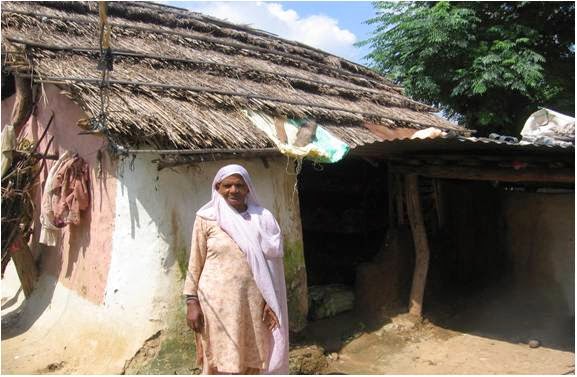
Mud shed used by Kandi women for silkworm rearing

Silk is the most elegant textile in the world with unparalleled grandeur, natural sheen, and inherent affinity for dyes, high absorbance, light weight, soft touch and high durability and known as the “Queen of Textiles”. Sericuture, the art and science of silk production is a livelihood opportunity for millions owing to its high employment generation potential, low capital intensive nature, while being a highly remunerative agro industry. The very nature of this industry with its rural based on-farm and off-farm activities and enormous employment generation potential has attracted the attention of the planners and policy makers to recognize the industry among one of the most appropriate avenues for socio-economic development of a largely agrarian economy like India. Today, mulberry is cultivated in about 0.192 million hectares in India. Around 6 million people from around 800,000 farm families are engaged in sericulture activities, concentrated mainly in the three southern states of Karnataka, Andhra Pradesh, and Tamil Nadu. The Silk Production Statistics estimated the world silk production to be 152868 metric tonnes. China’s contribution to world silk production is 126000 metric tonnes, and the share of Indian silk production is 23,679 tonnes metric tonnes (CSB, 2013).China and India together account for 97.9% of world silk production.
Among the various states of India, Jammu and Kashmir (J & K) is the oldest bivoltine silk producing state and covers an area of about 7082 ha under mulberry plantation. J &K produces around 133 MT of bivoltine raw silk from 1022 metric tonnes of annual cocoon production

The adoption level of improved technologies of mulberry cultivation and silkworm rearing is very low among J & K farmers. The major constraints are lack of awareness followed by traditional practices. Expensive and cumbersome technologies, lack of awareness, and non-availability of technology are attributed as the major reasons for non-adoption (Qadri et al.2010).  Creating awareness and interest among farmers about latest technologies and development of farmer-friendly and cost-effective technologies are needed.
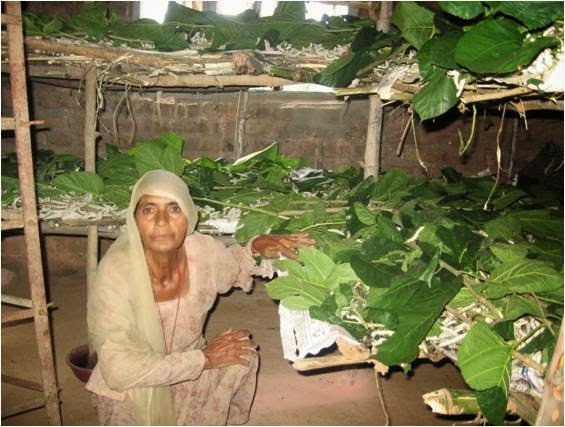
3-tier feeding method to overcome shortage of space
No wonder women are playing a very important role in the sericulture industry. It is seen that the sericulture activity brings regular income to the community without any bias of caste, creed, gender, or religion. As woman have crucial role in the activities of sericulture, it equally creates opportunities and makes them independent socially, economically and politically.  It is a well known fact that poverty affects mostly women. 60% of the world’s hungry are women.  Women work two-third of the world’s working hours, produce half of the world’s food, but earn only 10% of the world’s income and own less than one per cent of the world’s property. The gender target therefore needs to be bold and strong, moving away from measuring average progress towards focusing on the marginalized groups, such as women living in fragile area.
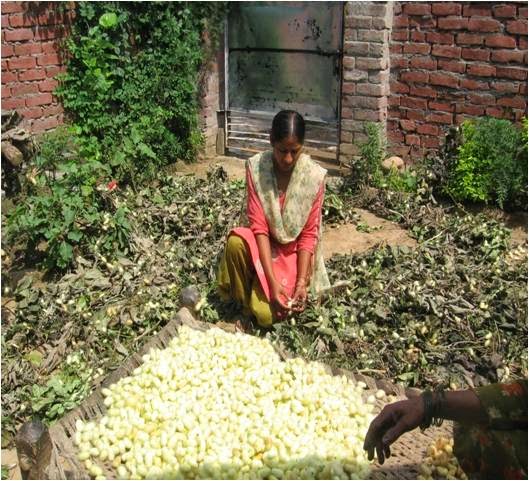
Cocoon harvest from Eucalyptus plant-shoot mountages
The submontane tract lying in the outer Himalayas of Jammu division of Jammu and Kashmir is locally termed as Kandi belt. Most of the terrain of Kandi is undulated and affected by vagaries of unpredictable weather further aggravated to prolonged dry spell. Moreover, marginal size of holding also adds to the worries of the farmers. In such conditions, something which provides sustainability is the use of traditional knowledge-wisdom developed by the people over many generations.
In Kandi belt of Jammu, women livelihoods mainly depend on rainfed maize and wheat crops. Owing to continuous research and improvement in recent years, sericulture has established its superiority over other principal crops. Employment opportunities in sericulture can be categorized under two heads; viz. opportunities related to mulberry cultivation and silkworm rearing and opportunities relating to silk reeling, twisting, weaving, and marketing. The latter is mostly undertaken in semi urban and urban areas. In the present work it was aimed to empower women of Kandi belt of Jammu through sericulture (mulberry cultivation and silkworm rearing).
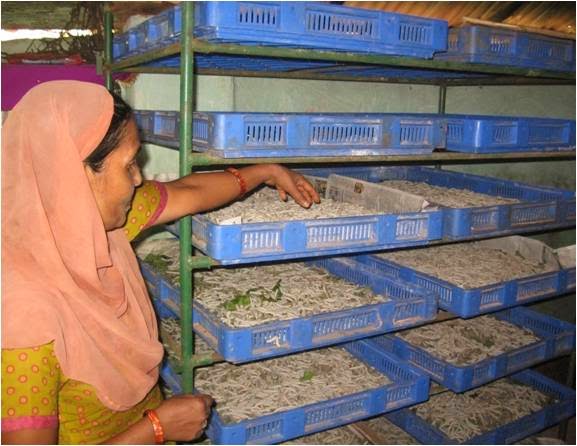
Newly introduced plastic tray rearing
Methodology Adopted:
From the female headed families, a total of 60 women were identified by selecting 20 in each Research Extension Center, operating in Kandi belt of Jammu region. Data on family size and structure, land holding, occupation, cast-wise distribution, monthly income, daily expenses, educational status and participation of men, women and children in silkworm rearing practices were recorded. An assessment was made of their level of knowledge and current level of livelihood. 
The women were trained at their doorsteps in the following current technologies:
Disinfection and hygiene,
Importance of Chawki rearing,
Care during moulting,
Late age silkworm rearing,
Use of bed disinfectants,
Role of temperature and humidity,
Identification of ripe (ready to spin) worms
Care during mounting,
Harvesting, sorting and marketing of cocoons,
Stifling and storage of cocoons,
Cocoon crafting
Land preparation for mulberry cultivation,
Application of manure and fertilizers,
Importance of green manure,
Improved mulberry varieties/silkworm hybrids,
Insect pests and diseases of mulberry and their control measures.
Demonstrations of silkworm rearing and plantation were carried in the field area of women participants. Thereafter, Chawki reared worms were given to women and cocoon yields were recorded and marketing data was collected. Impact of the peripatetic training was assessed and compared by the analysis of variance.
Results
The cumulative effect of peripatetic training was monitored by observing cocoon yield, price per kilogram of dry cocoons and income from sericulture of the adopted women in the present work.
Yield of Cocoons
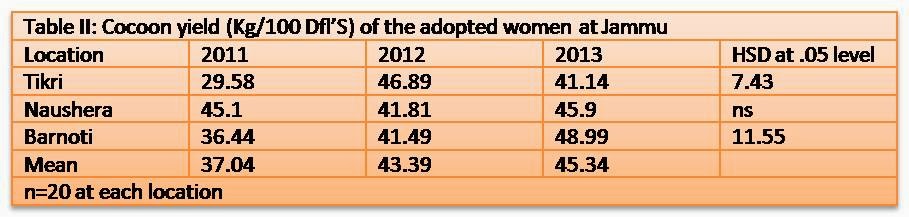
It can be seen from Table I that the average yield of cocoons per 100Dfl’s increased from the first year of 37 kg in 2011 to 45 kg in 2013. In Tikri area, the gain was substantial, where average cocoon yield per 100 Dfl’s increased upto 46.89 in 2012 from 29.58 in 2011 and 41.14 kg in 2013. However, the difference in cocoon yield between 2012 and 2013 were not significant in Tikri area. In Barnoti, the cocoon yield increased from 36.44 kg in 2011 to 41.49 kg in 2012 and 48.99 kg in 2013. The cocoon yield in Naushera could not be improved beyond 45 kg per 100Dfl’s during the present work.
Cocoon price
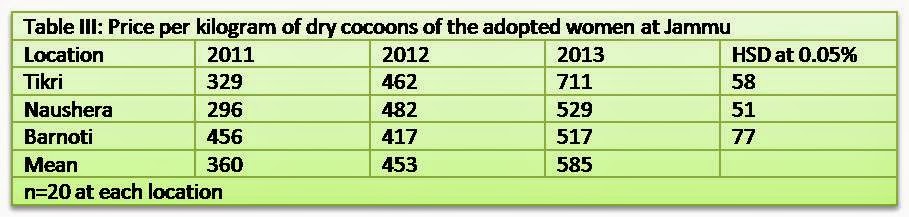
It can be seen from Table II that the average cocoon price of the adopted women in Jammu increased from Rs. 360 to Rs. 585 per kilogram. However, in Tikri area, the gain was more than double, where the cocoon price increased from Rs 329 in 2011 to Rs.711 per kg in 2013.
In Naushera, the cocoon price increased from Rs. 296 in 2011 to Rs. 529 per kg  in 2013.  And, in Barnoti, the cocoon price increased from Rs. 456 in 2011 to Rs. 517 in 2013.
Income from Sericulture
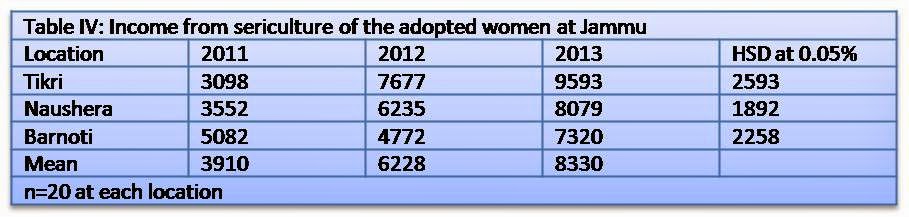
The average income of the adopted women from sericulture per crop increased from Rs. 3910 in 2011 to Rs. 8330 in 2013. In Tikri, the average income from sericulture increased nearly three times from Rs. 3098 in 2011 to Rs. 9593 in 2013. In Naushera, the income from sale of cocoons increased from Rs. 3552 in 2011 to Rs. 8079 in 2013.
And in Barnoti, the income increased from Rs. 5082 in 2011 to Rs. 7320.
Discussion
Sericulture technologies demonstrated to adopted women in the fragile Kandi belt of Jammu province during peripatetic training led to 39.14% increase in cocoon yield and 34.54% increase in Barnoti area. In Naushera area, the women harvested 45kg per 100 Dfl’S (40000 eggs) in the first year of the project itself and improvement beyond 45 kg could not be achieved during the project period due to the fragility of the area, being very close to Pakistan border. The average yield of cocoons per 100Dfl’S increased from the bench mark of 37.04 kg in 2011 to 45.34 kg in 2013 due to training impact. However, due to general price hike in the market, during the year2013, the income of the women from sericulture increased by 209.78% in Tikri, by 127.49% in Naushera and by 44.03% in Barnoti area.
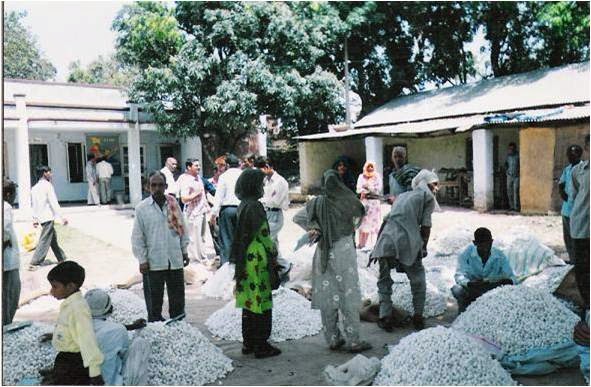
Women participating in cocoon auction  at R.E.C.Barnoti in Kandi belt
It is inferred that the new technologies of sericulture should be popularized by peripatetic training programme. Awareness programme should also be conducted during the field activity as per the need of the season for improving the bivoltine cocoon production.
References
Central Silk Board. (2013)NOTE ON THE PERFORMANCE OF INDIAN SILK INDUSTRY
& FUNCTIONING OF CENTRAL SILK BOARD. 26t h December, BANGALORE-560068
S. F. I. Qadri, M. A. Malik, A. Sabhat and F. A. Malik(2010)
ADOPTION OF IMPROVED SERICULTURAL PRACTICES BY SERICULTURISTS IN BORDER AREA OF KASHMIR.
Int. J. Agricult. Stat. Sci., Vol. 6, No. 1, pp. 197-201 

Read Previous stories by the author of this article 1, 2, 3

Contact Author: pandeyjammu@gmail.com 
HTML Comment Box is loading comments...

Followers

My Blog List